
My wife and I run a local advertising platform, so we spend a lot of time thinking about how small businesses can reach their neighbors without spending a fortune. We've tested, researched, or personally used every channel on this list.
Here are the cheapest ways to advertise a local business in 2026, ranked by cost and what you actually get.
1. Google Business Profile — Free
This is the single most important thing any local business can do, and it costs nothing.
Your Google Business Profile (formerly Google My Business) controls what people see when they search for your business or your category in Google Maps and local search results. It shows your hours, location, phone number, reviews, and photos.
What it costs: Free.
What you get: A listing in Google Maps, local pack results, and the Knowledge Panel when someone searches your business name.
The catch: Google owns the page. You can't fully control how it looks or what Google does with it. You're also competing with every other business in your area on Google's terms. And Google Business Profile has very limited visibility in AI search — ChatGPT, Perplexity, and Gemini don't typically cite GBP listings.
Verdict: Do this first. Today. If you haven't claimed your Google Business Profile, stop reading and go do it.
2. LocalSquare — $1/Month
Full disclosure: we built this. But we built it specifically because this price point didn't exist.
LocalSquare is a digital bulletin board for every town in America (43,000+ ZIP codes). You claim a square on your town's 10x10 grid board, upload your logo or a photo, and get a permanent visual ad plus your own SEO-optimized webpage.
What it costs: $1/month. No setup fees, no contracts, cancel anytime.
What you get: A visual pin on your town's board, a dedicated business page with structured data and schema markup, inclusion in directory and "Best in Town" pages, and visibility to AI search engines. Every page is server-side rendered and built to be cited by ChatGPT, Perplexity, Gemini, and similar tools.
The catch: LocalSquare is still growing. Your town's board might not have many other businesses on it yet. The SEO and AI visibility benefits compound over time, so this isn't an instant-gratification play.
Verdict: At $1/month, there's no reason not to do this alongside everything else. The permanent web page alone is worth more than a dollar. 10% of proceeds also go to charity.
3. Nextdoor — Free (Organic Posts)
Nextdoor is a neighborhood social network. Businesses can create a free Business Page and post updates visible to nearby residents. Neighbors can also recommend your business.
What it costs: Free for a Business Page. Paid "Local Deals" start around $2-3/day ($60-90/month).
What you get: Direct access to verified neighborhood residents. Recommendations from actual neighbors carry significant trust.
The catch: Organic reach is limited and declining (Nextdoor wants you to pay for promoted posts). The platform can feel hostile — neighbors complain more than they recommend. You also can't control the algorithm.
Verdict: Worth having a free page. Don't count on organic reach alone.
4. Facebook Business Page — Free (Organic Posts)
Every local business should have a Facebook page, but organic reach in 2026 is essentially dead. Facebook shows your posts to roughly 2-5% of your followers unless you pay to boost them.
What it costs: Free to create. Paid boosted posts start at $5/day. Effective ad campaigns typically require $300-500/month.
What you get organically: A business listing, reviews, a place to post updates. A social proof signal for people who search your business name.
The catch: Without paying, almost no one sees your posts. Facebook Ads can be effective but require ongoing budget and management. When you stop paying, visibility drops to zero.
Verdict: Create the page for social proof. Only invest in ads if you have the budget ($300+/month) and willingness to manage campaigns.
5. Community Bulletin Boards and Local Groups — Free
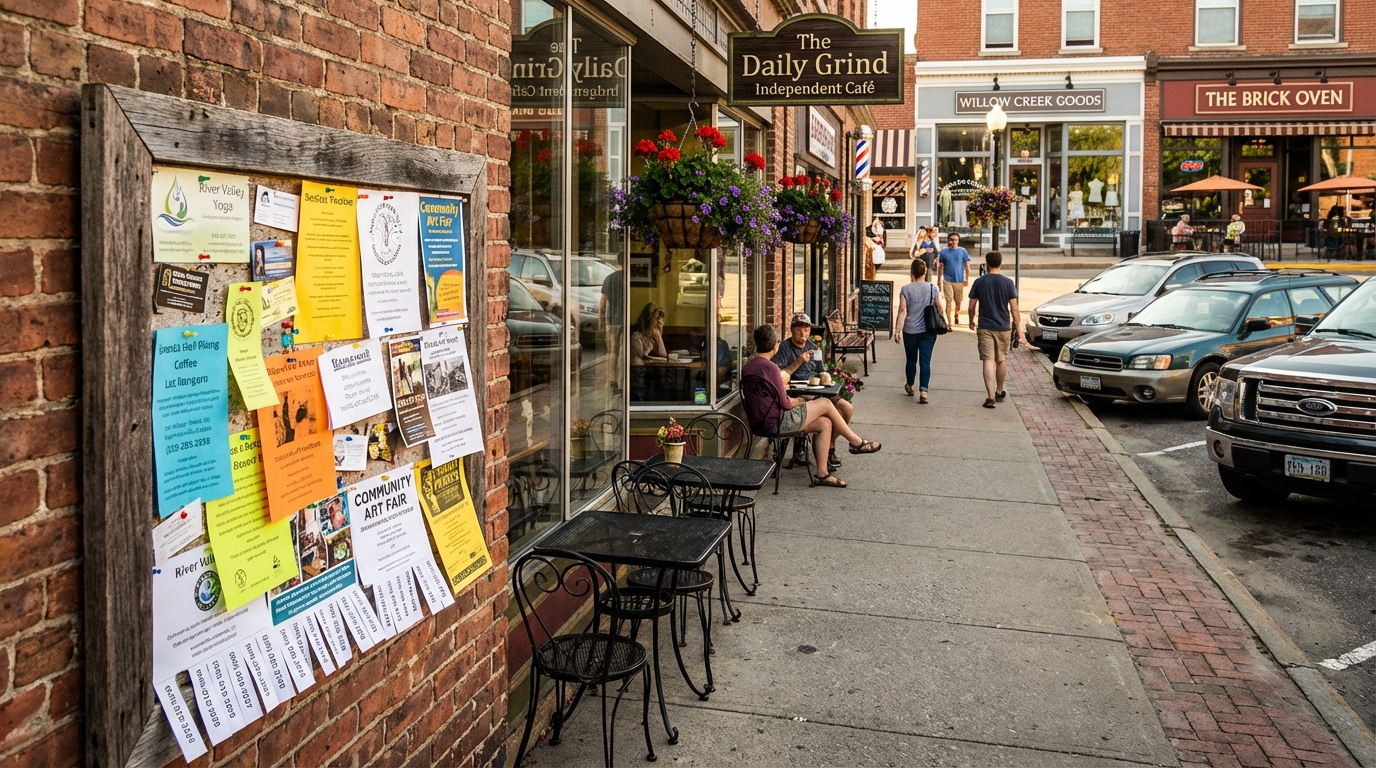
Physical bulletin boards at coffee shops, libraries, community centers, and laundromats still work. So do local Facebook Groups, neighborhood Slack channels, and community forums.
What it costs: Free (maybe $0.10 for a printed flyer).
What you get: Hyper-local visibility to people who actually live in your area.
The catch: It doesn't scale and it's not searchable. A flyer at the coffee shop reaches whoever walks in that week. No SEO benefit, no AI visibility, no permanent web presence.
Verdict: Do it anyway. Physical presence builds trust. Just don't rely on it as your only channel.
6. Instagram / TikTok — Free (Organic Content)
Visual platforms work well for certain local businesses: restaurants, salons, fitness studios, home services (before/after photos), retail shops.
What it costs: Free to post. Your time to create content.
What you get: A visual portfolio of your work. Potential for local discovery via hashtags and location tags.
The catch: Extremely time-consuming to do well. The algorithm favors consistent posting (3-5 times per week). ROI is hard to measure for local businesses. Zero SEO benefit — Instagram content is not indexed by search engines or AI models.
Verdict: Great if your business is visually compelling and you enjoy creating content. Not a substitute for web presence.
7. Yelp — Free Listing (Paid Starts ~$300/Month)
Yelp provides a free business listing with reviews, photos, and business information. Their paid advertising program puts you at the top of search results and on competitor pages.
What it costs: Free listing. Paid advertising starts around $300/month and can exceed $1,000/month for competitive categories.
What you get for free: A business profile page that often ranks well in Google for "[business type] near [location]" searches.
What you get for paid: Priority placement in Yelp search, ads on competitor listings, enhanced profile features.
The catch: Yelp's business model is controversial. Free listings can have negative reviews prominently displayed. Yelp controls the page and the ranking. Many business owners report feeling pressured to advertise. The page ranks well — but it's Yelp's page, not yours.
Verdict: Claim your free listing and respond to reviews. Think carefully before paying for Yelp ads — you're paying to compete on Yelp's platform for visibility on Yelp's pages.
8. Google Ads (Local Search) — $500-1,500/Month
Google Ads puts your business at the top of search results for specific keywords. For local services, this means appearing when someone searches "plumber near me" or "best pizza in [town]."
What it costs: $500-1,500/month for a competitive local market. Some categories (lawyers, HVAC) can cost $50+ per click.
What you get: Immediate visibility at the top of search results. Measurable clicks and calls.
The catch: Expensive. Requires ongoing management and optimization. The moment you stop paying, you disappear completely. No lasting SEO benefit. Not visible to AI search engines.
Verdict: Effective for businesses with enough margin to absorb the cost and enough volume to justify ongoing spend. Not viable for most solo operators or very small businesses.
The Bottom Line: What to Do If You're a Small Local Business in 2026
Here's the minimum viable local advertising stack, from cheapest to most expensive:
Tier 1 — Do these today (under $5/month): Claim your Google Business Profile (free). Claim a LocalSquare pin ($1/month). Post your business on any relevant local Facebook Groups (free).
Tier 2 — Do these this month (free but takes time): Create a Facebook Business Page. Claim your Yelp listing. Put a flyer on local bulletin boards. Post on Nextdoor.
Tier 3 — Do these if you have the budget ($300+/month): Run Facebook or Instagram ads. Run Google Ads for your top service keywords. Consider Yelp advertising if your category is strong on Yelp.
The biggest shift in 2026 is AI search. When someone asks ChatGPT or Perplexity "find me a good plumber in Springfield," the answer comes from indexed web pages with structured data — not from ad platforms. Having a real, crawlable web page for your business (like a Google Business Profile or a LocalSquare pin page) is now more valuable than it's ever been.
Find your town's board on LocalSquare →
Frequently Asked Questions
What is the single cheapest way to advertise a local business? Google Business Profile is free and should be the first thing every local business sets up. After that, a LocalSquare pin at $1/month is the cheapest way to get a dedicated, SEO-optimized web page for your business.
Do I need to spend money on Facebook or Google Ads? Not necessarily. Many small local businesses do fine with free and low-cost channels. Paid ads make sense when you have the budget ($300+/month) and want immediate, scalable results. But they should supplement your organic web presence, not replace it.
What's the best way to show up in AI search results like ChatGPT? AI models cite web pages with clear, structured content. Having a dedicated business page with schema markup (like what LocalSquare and Google Business Profile provide) gives you the best chance of being cited when someone asks an AI assistant about businesses in your area.
How important are online reviews for local businesses? Very important. Reviews on Google, Yelp, and Facebook influence both traditional search rankings and AI model responses. Ask satisfied customers to leave reviews — it's free and it compounds over time.
Is local SEO still worth it in 2026? More than ever. Local SEO now includes AI search optimization (sometimes called AEO or GEO). When AI assistants answer local business questions, they pull from the same indexed web pages that Google uses. Good local SEO benefits both traditional and AI search.